People visit your website but never contact you for one big reason: getting traffic is only half the job. Your website also has to attract the right people, answer their questions, build trust, and make the next step easy. Some visitors are simply shopping around for pricing or comparing companies, and that is normal. A healthy website may convert around 3% to 5% of visitors into inquiries, depending on the industry and traffic source. The bigger issue is attracting hundreds of visitors who were never likely to become customers in the first place. Good marketing focuses on qualified traffic, not traffic for traffic’s sake.
In this article:
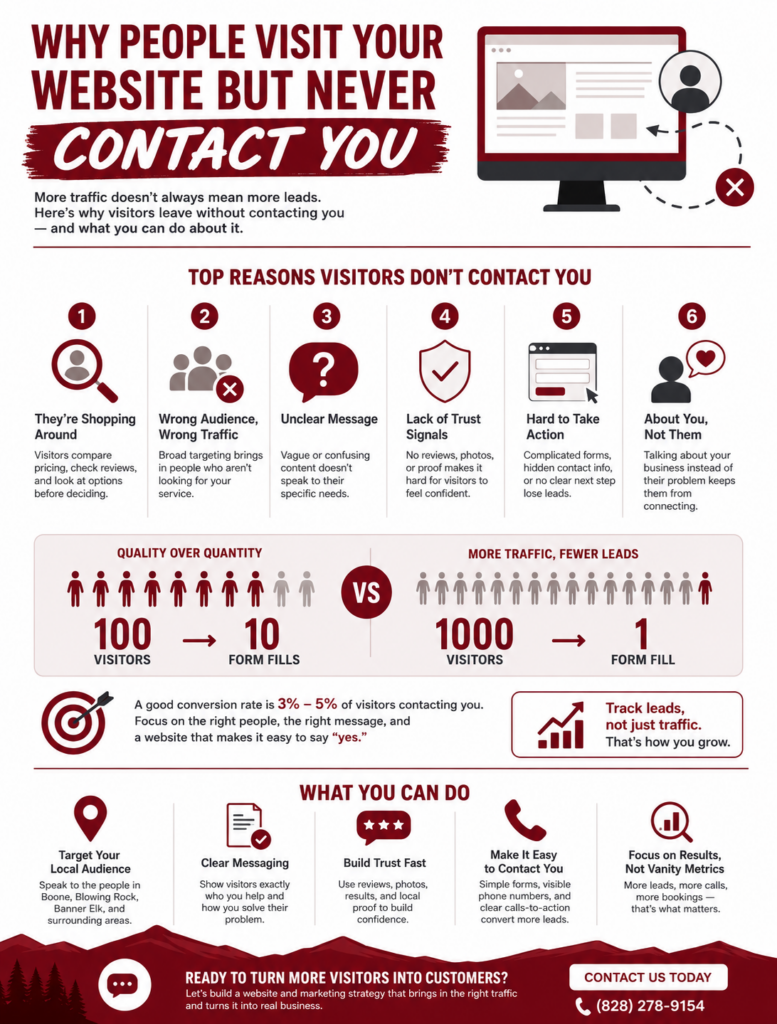
–Qualified traffic matters more than high traffic: 100 relevant visitors who need your service can outperform 1,000 poorly targeted visitors.
–Your website should quickly build trust and guide action: Clear messaging, reviews, local proof, and easy contact options help turn visitors into leads.
–Target the right local audience: For businesses in Boone, Blowing Rock, Banner Elk, and surrounding areas, SEO should focus on people actively searching for your services nearby.
Kingdon Marketing helps increase views and conversions on your website with SEO. Check out services and contact us when you’re ready to increase revenue for your small business.
More Website Traffic Does Not Automatically Mean More Leads
Traffic numbers look nice in a monthly report. Watching your website jump from 200 visitors to 1,000 visitors feels like progress.
But did the phone ring?
Did anyone fill out the contact form?
Did you book more appointments?
If not, that traffic might not be helping much.
It is better to have 100 highly relevant visitors and receive 10 form submissions than to attract 1,000 visitors and receive one. The smaller website technically has less traffic, but it is doing a much better job of supporting the business.
At Kingdon Marketing, we look beyond clicks and impressions. Traffic matters, but traffic needs a purpose. The goal is getting the right people onto your website and giving them enough confidence to take action.
Some Visitors Are Just Shopping Around
Not everyone who visits your website is ready to call today.
People compare pricing. They open five tabs. They read reviews. They check portfolios. They may visit your site Monday, think about it for a week, and come back the following Friday.
That is normal buyer behavior.
A website cannot force every visitor to become a lead, nor should that be the goal. A solid website instead helps qualified customers quickly decide whether your company seems like the right fit.
This is why a 3% to 5% conversion rate can still produce meaningful results. If 500 relevant people visit your website and 20 contact you, that could represent plenty of new business.
The key word there is relevant.
Your Website May Be Attracting the Wrong Audience
SEO can increase traffic. Google Ads can increase traffic. Social media can increase traffic.
But more is not always better.
Imagine you own an HVAC company in Boone, NC, and your website ranks nationally for a broad article about how air conditioners work. You might generate thousands of visitors from Texas, California, New York, and everywhere in between.
Interesting? Sure.
Useful for booking HVAC calls in Boone? Probably not.
A strong SEO agency should focus on search terms connected to what your ideal customer actually wants. That often means targeting services, geographic areas, problems, and questions that indicate someone could realistically become a customer.
Your website should speak directly to the people you want to serve — not everyone with an internet connection.
Your Message Is Too Broad
One of the most common website problems is vague messaging.
“We provide quality solutions.”
“We help businesses succeed.”
“Your trusted partner.”
Okay… but what do you actually do?
A visitor should understand within seconds who you serve, what you offer, where you work, and why they should consider contacting you.
For example, a Boone-based contractor will usually benefit more from messaging specifically written for homeowners in Boone, Blowing Rock, Banner Elk, and surrounding communities than generic language designed to appeal to everyone.
Specific messaging helps the right person think, “Yep, this is for me.”
That is an important step toward conversion.
Visitors Do Not Have Enough Reason to Trust You
Most website visitors do not know you yet.
They need proof.
When it comes to choosing a local service provider, people often look for reviews, photos, past projects, recognizable locations, credentials, clear service information, and signs that the business is active and responsive.
Your website should make that proof easy to find.
Useful trust signals include:
- Real customer reviews and testimonials
- Photos of completed work, staff, or projects
- Clear service areas and local information
- Case studies or measurable results
- Transparent information about your process
- Easy-to-find phone numbers and contact options
- Helpful content that demonstrates knowledge
The goal is not to brag. It is to remove uncertainty.
Your Website Makes Contacting You Too Difficult
Sometimes the problem is surprisingly simple.
The visitor wants to contact you, but the website makes them work for it.
Maybe your phone number is buried in the footer. Maybe your contact form asks 14 questions. Maybe the “Contact Us” button disappears on mobile. Maybe someone submits a form and has no idea what happens next.
Your call to action should be obvious.
Tell people exactly what to do. Call. Request a quote. Schedule a consultation. Book an appointment.
Then make that action easy from every important page.
Good web design is not about adding more buttons everywhere. It is about creating a logical path from interest to action.
Your Website Is Talking About You Instead of the Customer
Business owners naturally want to explain their company.
“We have 20 years of experience.”
“We use state-of-the-art equipment.”
“We are committed to quality.”
Those details can help, but visitors are usually asking a different question:
Can you solve my problem?
Your website should connect your capabilities to the customer’s needs.
Instead of only explaining that you offer SEO, explain how SEO can help a local company appear when potential customers search Google.
Instead of simply saying you build websites, explain how a better website can turn more visitors into calls, appointments, bookings, or form submissions.
Make the customer the main character.
Measure Leads, Not Just Visitors
Google Analytics and Google Search Console can tell you a lot about traffic, rankings, impressions, and behavior.
Those numbers are useful. They are not the finish line.
Look at what visitors actually do after they arrive.
How many people call?
How many submit forms?
Which pages generate inquiries?
Which keywords attract leads?
Where do people leave?
A digital marketing agency should be helping you connect website activity to real business outcomes.
If traffic climbs but inquiries stay flat, something needs attention. It could be targeting, messaging, site design, search intent, your offer, or the quality of the traffic itself.
The Goal Is the Right Traffic and the Right Website
You do not need every person on Google visiting your website.
You need the people who are actively looking for what you sell.
Then your website needs to clearly explain why your company deserves consideration, answer common questions, establish trust, and give visitors an easy next step.
That is where SEO and web design work best together. SEO brings qualified people through the door. Your website helps turn some of those visitors into actual conversations.
At Kingdon Marketing in Boone, NC, we help local businesses build websites and SEO strategies around business growth, not vanity metrics. If your traffic is increasing but your leads are not, call (828) 278-9154 to talk through what may be happening.
Other Articles to Checkout:
- How Many Website Visitors Do You Need to Generate a Lead?
- 7 Signs Your Small Business Is Ready to Hire an SEO Agency
- How Do You Know If You’re With the Right SEO Company?
- Is SEO Worth It for a Small Local Business? How?
- How Long Does Local SEO Take for a Small Business to Start Working?
- How Much Should a Small Business Spend on SEO Each Month?