How many website visitors do you need to generate a lead? The answer is a little frustrating, but accurate: it depends. One business might generate several inquiries from 100 website visitors, while another could bring in hundreds of visitors and hear crickets. Traffic matters, but the quality of that traffic and the website receiving it matter just as much. As a general benchmark, a website converting around 3% to 5% of visitors into form submissions can be performing well. That means 100 qualified visitors could potentially generate three to five leads. Before chasing more traffic, though, make sure your website is actually prepared to turn those visitors into customers.
In this article:
–Expect roughly 3–5% of qualified website visitors to convert into leads as a useful starting benchmark.Website Traffic Alone Does Not Generate Leads
–Traffic quality matters more than traffic volume, especially for local businesses targeting customers in Boone, NC and surrounding areas.
–Strong website design, SEO visibility, and clear calls to action need to work together to consistently generate leads.
Kingdon Marketing helps increase views and conversions on your website with SEO. Check out services and contact us when you’re ready to increase revenue for your small business.
Website Traffic Alone Does Not Generate Leads
There is a common SEO trap that goes something like this:
More traffic = more leads.
Sometimes, yes. But not automatically.
A website can receive 5,000 visitors every month and generate fewer leads than another website receiving 500. The difference usually comes down to who is visiting the website and what happens after they arrive.
Think about a local HVAC company in Boone, NC. If 500 people arrive after searching phrases like “AC repair Boone NC” or “heating repair near me,” that traffic has strong commercial intent. Those visitors probably need an HVAC company.
Now imagine another website receives 5,000 visitors because one informational blog post ranks nationally for a broad question. Great traffic numbers. Maybe not so great for the phone.
The goal isn’t simply getting people to your website. It is getting the right people there and making the next step obvious.
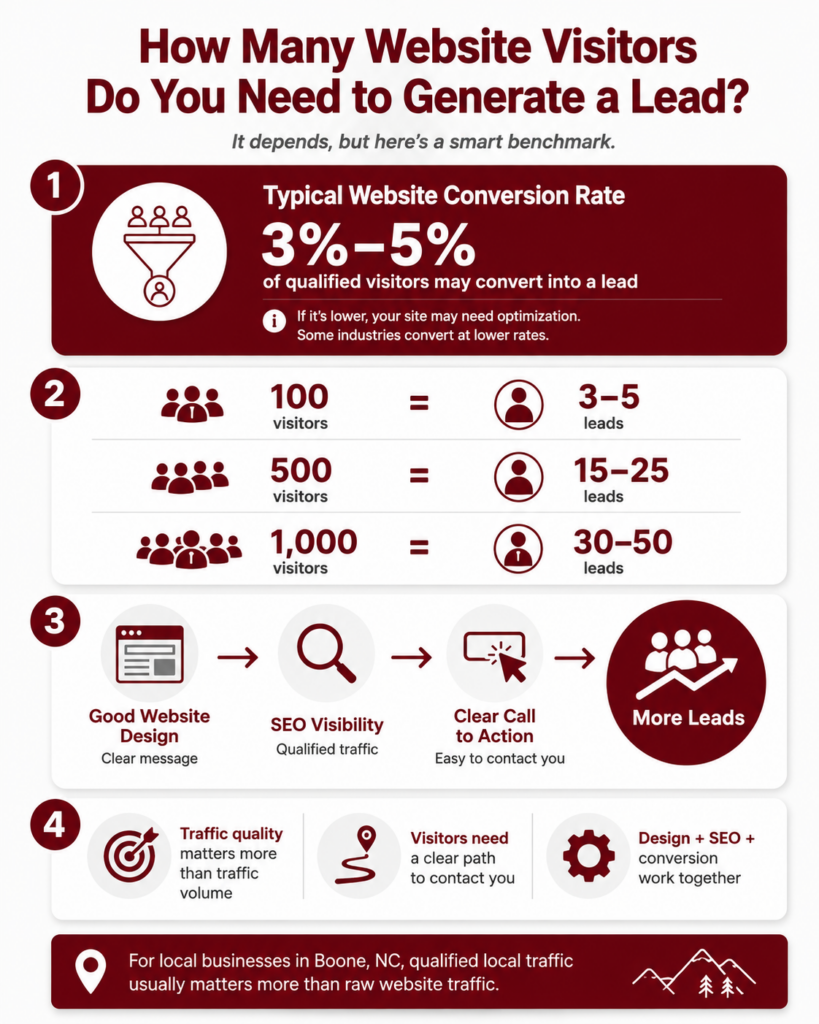
A 3% to 5% Website Conversion Rate Is a Useful Starting Point
For many service businesses, we like to use roughly 3% to 5% as a practical website lead conversion benchmark for form submissions.
The math is pretty simple:
- 100 visitors at 3% conversion = 3 leads
- 100 visitors at 5% conversion = 5 leads
- 500 visitors at 3% conversion = 15 leads
- 500 visitors at 5% conversion = 25 leads
- 1,000 visitors at 3% conversion = 30 leads
- 1,000 visitors at 5% conversion = 50 leads
This is not a universal rule. Your industry, location, services, price point, traffic source, sales cycle, and definition of a conversion can dramatically change those numbers.
A roofer receiving emergency storm-damage searches might convert differently than an interior designer whose clients research options for weeks. A restaurant, attorney, therapist, real estate agent, contractor, and B2B company are all playing slightly different games.
That is why conversion rates need context.
Is Your Website Designed to Generate Leads?
Before deciding you need more visitors, look at the website itself.
A beautiful website is nice. A beautiful website that generates business is better.
Ask yourself what you want someone to do within the first few seconds of arriving. Call you? Schedule a consultation? Request a quote? Complete a contact form?
That action should be painfully obvious.
Your primary call-to-action button should stand apart visually from secondary buttons. If everything on the website looks equally important, nothing looks important.
Contact buttons should also appear throughout longer pages instead of forcing someone to scroll back to the top after they finally decide to reach out.
When it comes to website design, clarity almost always beats cleverness.
Can People Actually Find Your Website?
Next comes SEO.
You can build the cleanest, fastest, most persuasive website in Boone, NC, but it cannot generate many leads if nobody finds it.
Search engine optimization helps connect your business with people already looking for the products or services you provide.
That includes optimizing pages around relevant keywords, creating strong service pages, targeting geographic areas, improving your Google Business Profile, earning backlinks, publishing useful content, and maintaining the technical health of the website.
A local SEO agency should not simply promise “more traffic.” The better question is:
Can we increase relevant traffic from people who might actually become customers?
That distinction matters.
Kingdon Marketing works with businesses in Boone, Blowing Rock, Banner Elk, West Jefferson, and markets outside the High Country to improve both sides of this equation: getting found and converting the people who arrive.
Is It Clear Where Visitors Should Convert?
This one sounds obvious until you start looking at websites.
Sometimes the phone number is tiny.
Sometimes the contact button blends into everything else.
Sometimes the only form lives on a contact page buried inside the navigation.
Sometimes visitors are asked to complete a 14-field form just to ask a basic question.
That is friction.
Your website should make contacting your business easy. Depending on your business, that might mean prominent phone numbers, short forms, quote-request buttons, scheduling tools, or clear calls to action throughout each service page.
Give visitors direction. Do not make them solve a puzzle.
The Quality of Your Website Visitors Matters
Imagine you run a web design company in Boone.
One visitor searches “cool website examples.”
Another searches “Boone NC website design company.”
Which visitor would you rather have?
Easy answer.
SEO traffic should increasingly match the services you actually sell, the locations you serve, and the types of customers you want.
This is also why obsessing over raw Google Analytics traffic can be misleading. A sudden increase in visitors looks exciting on a report, but revenue does not care about pageviews.
Businesses need qualified leads.
What If Your Website Converts Below 3%?
A conversion rate below 3% does not automatically mean your website has a problem. Some industries naturally convert at lower rates, especially businesses with expensive services, long sales cycles, or customers who do a lot of research before reaching out.
Still, it is worth investigating.
Look at your traffic sources. Review which pages visitors enter through. Check mobile usability. Make sure forms work. Review your calls to action. Study where people leave.
Google Analytics, Google Search Console, and behavior tools can help you identify where the problem sits.
You may find that you do not need another 1,000 visitors.
You may simply need to do a better job converting the 1,000 you already have — which can be a much faster path to growth.
Traffic + SEO + Conversion Creates Lead Generation
A website becomes a stronger lead-generation tool when three things work together:
- Strong website design: Visitors quickly understand who you help, what you offer, and why they should trust you.
- SEO visibility: Your website appears when qualified prospects search for your services.
- Clear conversion paths: Visitors know exactly how to call, schedule, request a quote, or submit a form.
Get those three pieces working together and your website is in a much better position to produce consistent leads.
Traffic is still important. You need people coming through the door.
But before pouring more money into SEO, Google Ads, social media, or another traffic source, make sure the door leads somewhere useful.
At Kingdon Marketing, we help small businesses build websites and SEO strategies around actual business growth, not vanity metrics. If you want to understand whether your website needs more visitors or simply needs to convert more of the visitors you already have, call (828) 278-9154 and we can take a look.
Other Articles to Checkout:
- 7 Signs Your Small Business Is Ready to Hire an SEO Agency
- How Do You Know If You’re With the Right SEO Company?
- Is SEO Worth It for a Small Local Business? How?
- How Long Does Local SEO Take for a Small Business to Start Working?
- How Much Should a Small Business Spend on SEO Each Month?
- How to Increase Website Traffic with SEO Without Spending More on Ads