Yes, you can rank in a city where your business is not physically located, but Local SEO usually works best when you expand outward from your home base instead of trying to jump across the map. Think of your service area like a growing circle. Start where your business has the strongest local relevance, then build visibility in nearby towns, then move farther out as your website earns authority. For a Boone, NC business, that could mean targeting Blowing Rock, Banner Elk, and West Jefferson first, followed by places like Wilkesboro, Hickory, and Lenoir as your reach grows over time.
In this article:
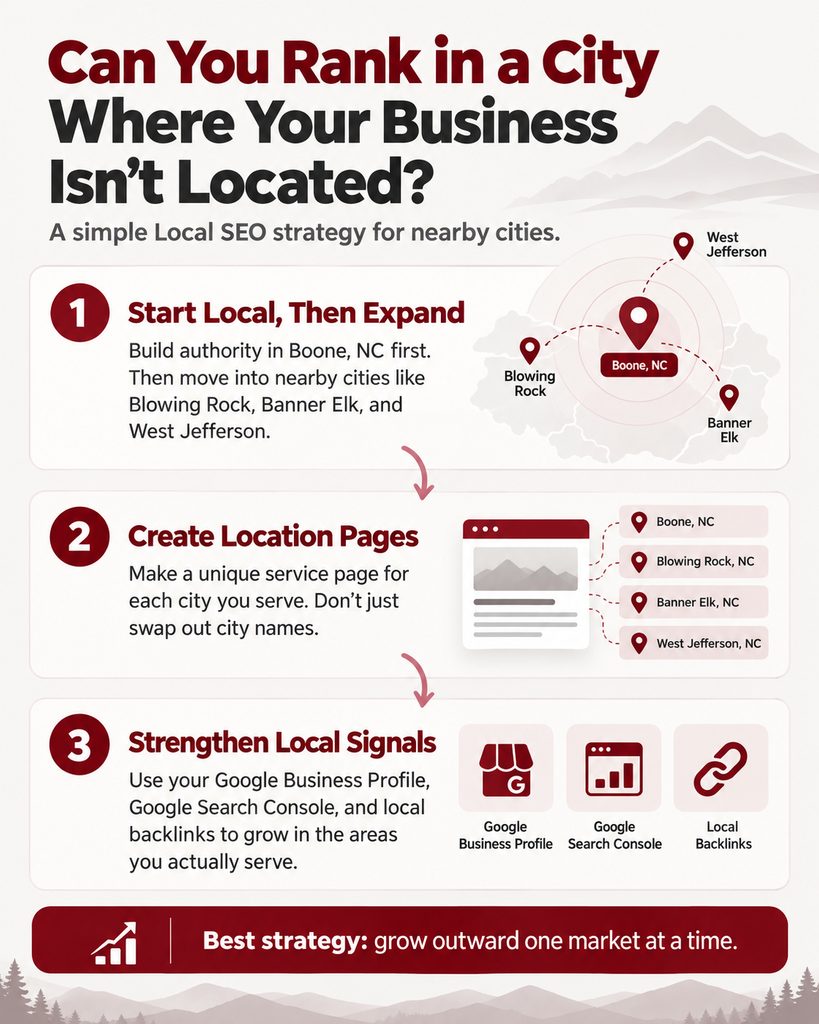
–Start local, then expand outward: Build authority in Boone, NC first, then target nearby cities like Blowing Rock, Banner Elk, and West Jefferson.
–Create useful location landing pages: Target each city with unique, service-focused content instead of duplicating the same page with a different city name.
–Strengthen local signals: Use Google Business Profile, Google Search Console, and local backlinks to support rankings in the areas you actually serve.
Kingdon Marketing helps increase views and conversions on your website with SEO. Check out services and contact us when you’re ready to increase revenue for your small business.
Think of Local SEO Like Expanding a Radius
Trying to rank in the next town over is very different from trying to rank hundreds of miles away. Google says local results are primarily influenced by relevance, distance, and prominence. Distance matters because Google is trying to connect searchers with businesses that make sense for the location tied to their search.
That is why we usually recommend starting from the center and extending the diameter outward.
Imagine you own a pressure washing company in Boone, NC. Boone should be the center of your strategy. Once your website has strong service content there, begin targeting nearby markets such as Blowing Rock, Banner Elk, and West Jefferson. From there, you might expand toward Wilkesboro, Hickory, or Lenoir if you actually provide services in those areas.
The goal is not to claim every city you can find. It is to steadily build a larger footprint around the places your company realistically serves.
Start With Location Landing Pages
Location landing pages are one of the best ways to expand Local SEO visibility.
Instead of asking one generic service page to rank everywhere, create useful pages focused on individual markets. A pressure washing company might have pages for “Pressure Washing in Boone, NC,” “Pressure Washing in Blowing Rock, NC,” and “Pressure Washing in West Jefferson, NC.”
Each page should give someone in that location a real reason to stay. Include the services you provide there, nearby communities you serve, local project information, customer questions, photos when appropriate, and a clear way to contact your business.
Avoid copying the same page repeatedly and only changing the city name. Google warns against substantially similar pages built mainly to rank for different cities and funnel users to the same destination.
A strong location page can include:
- The primary service you provide in that city
- Nearby towns, neighborhoods, or communities you serve
- Local project examples, photos, or testimonials
- Frequently asked questions for that market
- Internal links to services and nearby location pages
- A clear call to request a quote or contact your team
Use Search Console to Find Your Next City
You do not always have to guess where to expand.
At Kingdon Marketing, we use Google Search Console to see where our website is beginning to earn impressions and rankings. You can also see some of the locations we target in our website footer. If Google is already showing your site for searches connected to a nearby city, that can be a useful signal that the market deserves more attention.
That data can help guide your next landing page.
You can also build pages for cities you already serve before the search data appears. Keyword research is helpful, but your real service territory matters too. If your team regularly works in a town and you want more customers there, a thoughtful location page can make sense.
Your Google Business Profile Still Matters
When it comes to Local SEO, your website and Google Business Profile should support each other.
Google recommends keeping your Business Profile complete, accurate, and current. It also says local prominence can be influenced by information from across the web, including links and reviews.
Make sure your profile accurately reflects your business, services, hours, service area, photos, and other useful details. For service-area businesses, list areas you genuinely serve. Do not create fake offices or addresses just to appear closer to another city. Google’s guidelines specifically call for accurate addresses and service areas.
Your Google Business Profile may be strongest near your real location, while your website can reach farther through organic search.
Build Local Authority Where You Want to Grow
Location pages are only part of the strategy. You also want signals showing that your business has a real connection to the communities you target.
Look for local backlink opportunities through chambers of commerce, nonprofits, event organizers, complementary businesses, local publications, schools, and community groups. Sponsoring an event, supporting a charitable effort, contributing useful information, or building a real partnership can lead to relevant mentions and links.
Those relationships can bring referral traffic too — not just SEO value.
Can You Rank Across the Country?
Possibly, but that is usually a different strategy.
A Boone-based local service business will have a much harder time building local visibility in a distant market with no real presence or connection there. Local search is geographically influenced by design.
That does not mean your website cannot rank nationally for informational searches. Strong blogs, guides, and resources can reach people anywhere. Ecommerce is also different. Online stores can target customers nationally through product, category, informational, and shopping-focused SEO. The radius strategy here is specifically for Local SEO and service-area businesses.
Grow Outward, One Market at a Time
The best Local SEO expansion strategy is usually straightforward: strengthen your home market, build nearby city pages, watch the data, and keep extending your reach.
Improve your Google Business Profile. Use Search Console to spot opportunities. Earn local backlinks through real community involvement. Most importantly, target markets that actually make sense for your business.
You do not need to cover the whole map at once. Start at the center, build authority, and expand the circle from there.
If you’re ready to grow your visibility beyond your home base, Kingdon Marketing can help you build a Local SEO strategy that makes sense for the areas you actually serve. From location landing pages and Google Business Profile optimization to Search Console insights and local backlink opportunities, we focus on steady, practical growth that brings in the right traffic and leads. Contact Kingdon Marketing to talk about expanding your reach in Boone, Blowing Rock, Banner Elk, West Jefferson, and beyond.
Other Articles to Checkout:
- The 10 Pages Every Local Service Business Website Should Have
- Does Your Small Business Website Have Too Many Pages or Not Enough?
- Should You Put Your Prices on Your Website?
- Why People Visit Your Website but Never Contact You
- How Many Website Visitors Do You Need to Generate a Lead?
- 7 Signs Your Small Business Is Ready to Hire an SEO Agency