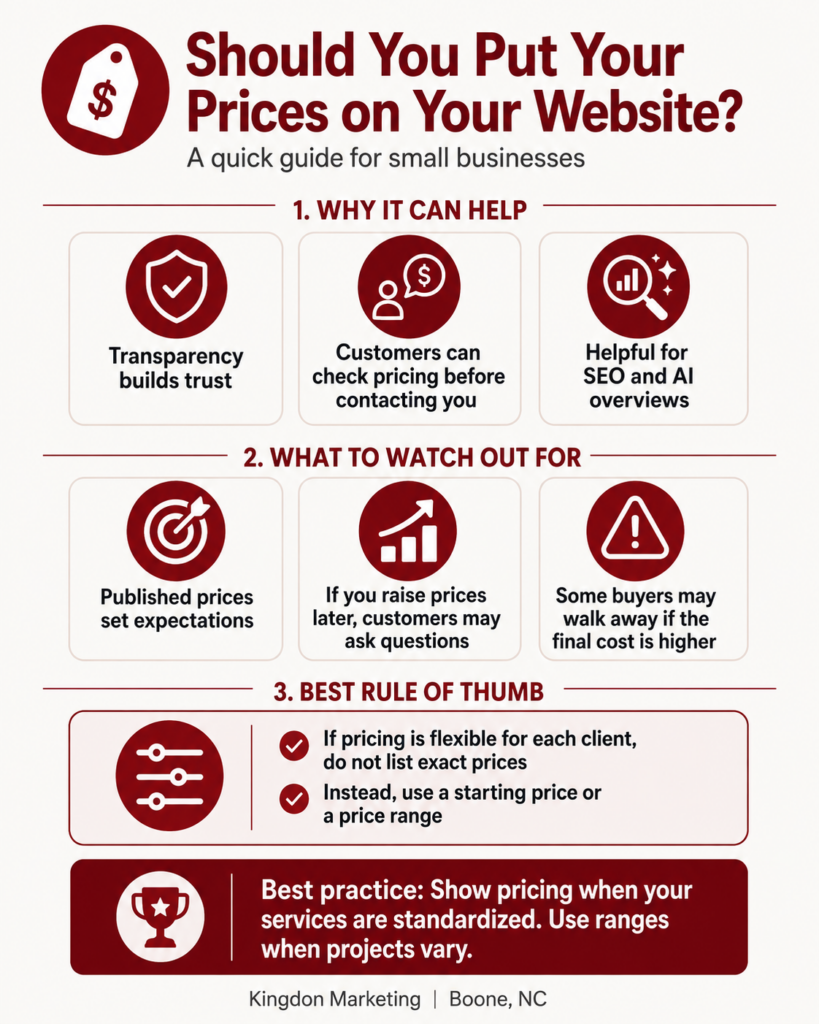
Should you put your prices on your website? For many businesses, yes, or at least give customers a realistic starting price or range. Publishing pricing creates transparency, helps potential customers decide if your services fit their budget, and can even give search engines and AI tools more useful information about your business. But there is a catch. Once you publish a price, customers tend to remember it. If your services are highly customized or your pricing changes regularly, putting exact numbers online can create more problems than it solves. The right choice depends on how predictable your pricing really is.
In this article:
–Show pricing for transparency: Clear prices or starting ranges help customers know what to expect before contacting you.
–Use pricing to qualify better leads: Visitors can quickly decide if your services fit their budget, saving time on both sides.
–Be flexible when pricing varies: For custom services, use starting prices or ranges instead of fixed rates, especially for businesses in Boone, NC and surrounding areas.
Kingdon Marketing helps increase views and conversions on your website with SEO. Check out services and contact us when you’re ready to increase revenue for your small business.
Why Putting Prices on Your Website Can Be a Good Idea
Think about how you shop for services yourself.
You find a company on Google, look through its website, decide you like what you see, and then start wondering about the obvious question: “How much is this going to cost me?”
If there is absolutely no indication of price, you have to decide if contacting the company is worth the effort.
Some people will.
Others will hit the back button.
Showing pricing removes some of that uncertainty.
For a small business, transparency can also create trust before you ever talk to the potential customer. You are essentially saying, “Here is roughly what you should expect. No surprises.”
That can make the sales conversation much easier.
Pricing Helps Qualify Potential Customers
Not every website visitor needs to become a lead.
You want the right visitors to become leads.
If your service costs $1,500 and someone only has a $200 budget, there probably isn’t much value in spending 30 minutes on a sales call together. Publishing your pricing gives that person an opportunity to recognize the mismatch before reaching out.
At the same time, someone who sees your $1,500 price and thinks, “That’s reasonable,” is arriving at the conversation much more qualified.
Pricing can help:
- Set realistic expectations before someone contacts you
- Reduce inquiries from people with budgets far below your rates
- Give serious customers more confidence about reaching out
- Shorten sales conversations because pricing is not a complete surprise
- Make your website more useful for people actively comparing providers
That doesn’t mean every visitor needs to know exactly what they will pay. Even something as simple as “Services start at $1,500” can provide valuable context.
Website Pricing Can Also Help With SEO and AI Search
There is another reason businesses should think about displaying pricing: search behavior is becoming increasingly specific.
People don’t always search for something broad like “SEO company.”
They may search:
“How much does SEO cost for a small business?”
“Website design under $5,000.”
“Average cost of local SEO.”
“How much should a small business website cost?”
If your website provides clear information about pricing, services, and what customers receive for that price, Google has additional context about your business.
That information can also be useful for AI-powered search results.
Google’s AI features and other AI search platforms attempt to answer detailed questions directly. Clear, structured pricing information gives these systems something concrete to interpret when users ask cost-related questions.
You shouldn’t publish prices purely because you think it will magically increase rankings. It won’t. But useful pricing information can make a page more complete and relevant to the questions potential customers are actually asking.
The Biggest Problem With Publishing Your Prices
Once you put a number on your website, people remember it.
Imagine your website says:
“Website design starts at $2,500.”
Six months later, you change your process, add more services, hire additional team members, and increase your starting price to $3,500.
A previous visitor might come back expecting the original rate.
Even after you update your website, you may hear:
“I thought your websites were $2,500?”
That does not mean increasing your prices is unreasonable. Businesses change. Services improve. Costs increase.
But publishing prices creates an anchor in the customer’s mind — and changing that anchor sometimes requires an explanation.
This is particularly important for businesses that adjust pricing frequently.
Don’t Publish Exact Pricing If Every Project Is Different
Some businesses simply don’t have standardized pricing.
A contractor might need to see the property before providing an estimate.
A marketing agency might work with a five-location business very differently than a one-person startup.
A commercial cleaning company might base pricing on square footage, frequency, staffing requirements, building type, and dozens of other variables.
Trying to force those services into one neat price can create confusion.
When it comes to highly customized services, a pricing range or starting price often makes more sense than an exact number.
Instead of saying:
“SEO costs $1,000 per month.”
You could say:
“Our SEO plans typically range from $750 to $2,000 per month depending on your market, goals, competition, and services.”
Now the customer has useful information without assuming every client receives the same package.
You Have More Options Than “Show Pricing” or “Hide Pricing”
Businesses sometimes treat this as an all-or-nothing decision.
It doesn’t have to be.
You could publish exact prices if you offer standardized services or products.
You could publish starting prices if your services have a predictable minimum investment.
You could publish pricing ranges when projects vary.
You could also explain the factors that affect pricing without publishing a specific number.
For example, a web design company could explain that costs depend on the number of pages, custom functionality, ecommerce requirements, copywriting, integrations, and SEO.
That still gives the customer useful information.
More importantly, it demonstrates that there is a reason behind the price.
So, Should Your Business Put Prices on Its Website?
If your pricing is fairly predictable, putting prices or starting prices on your website is usually worth considering.
It gives customers clarity. It can improve lead quality. It answers one of the biggest questions potential customers have before contacting a business. It can also create helpful content for traditional search engines and AI-powered search results.
But if every project requires a custom proposal, don’t trap yourself with an overly specific number.
Give people enough information to understand what they might spend without promising a price you cannot realistically guarantee.
The goal isn’t simply to put a dollar amount on the page.
The goal is to make it easier for the right customer to decide, “Yes, this company could be a good fit.”
At Kingdon Marketing in Boone, NC, we help small businesses build websites and SEO strategies around questions real customers are already asking. If you want your website to attract better traffic and turn more of those visitors into leads, call (828) 278-9154 to talk about your marketing strategy.
Other Articles to Checkout:
- Why People Visit Your Website but Never Contact You
- How Many Website Visitors Do You Need to Generate a Lead?
- 7 Signs Your Small Business Is Ready to Hire an SEO Agency
- How Do You Know If You’re With the Right SEO Company?
- Is SEO Worth It for a Small Local Business? How?
- How Long Does Local SEO Take for a Small Business to Start Working?