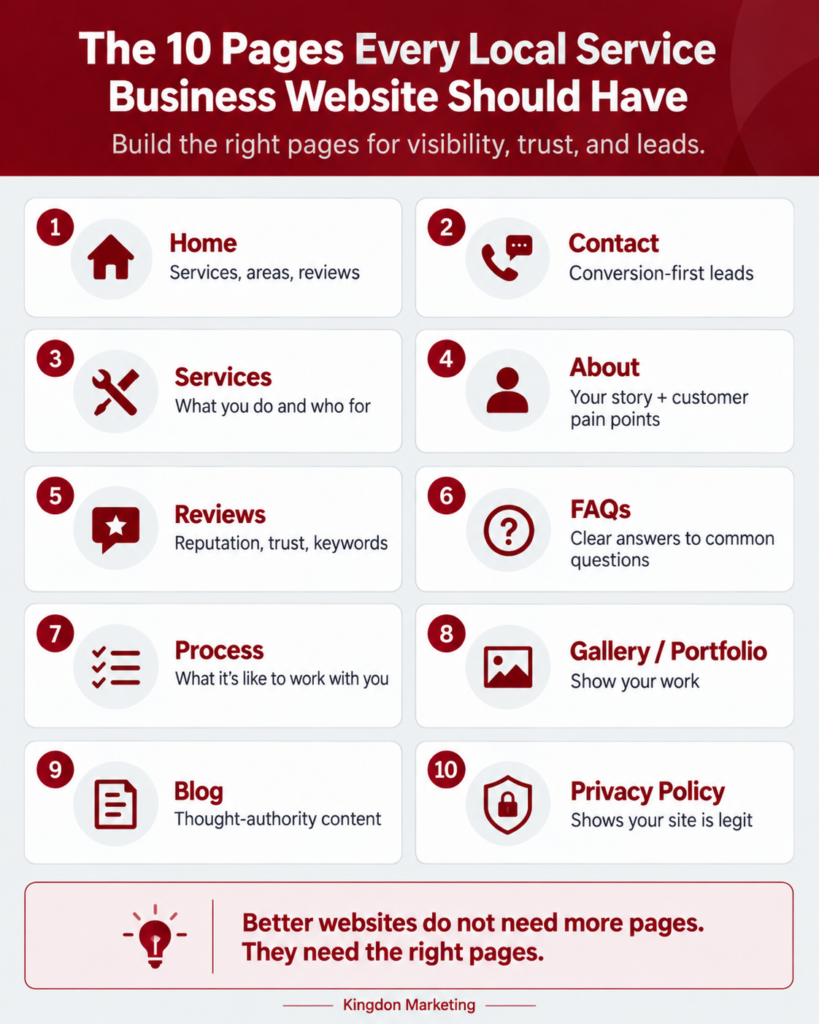
A local service business website should have 10 core pages: Home, Contact, Services, About, Reviews, FAQs, Process, Gallery or Portfolio, Blog, and Privacy Policy. Each page has a different job. Some help potential customers understand what you do. Others build trust, answer questions, support SEO, or make it easier for someone to contact you. Together, they give Google, AI search platforms, and actual humans a clearer picture of your business. You do not need a giant website packed with filler. You need the right pages, useful information, and a clear path that turns visitors into leads.
In this article:
–Build the 10 essential pages first: Home, Contact, Services, About, Reviews, FAQs, Process, Gallery, Blog, and Privacy Policy.
–Give every page a clear job: Use each page to improve SEO, answer questions, build trust, or turn visitors into leads.
–Expand strategically for local SEO: Add service pages, service-area pages, and useful blog content for Boone and surrounding High Country markets as your website grows.
Kingdon Marketing helps increase views and conversions on your website with SEO. Check out services and contact us when you’re ready to increase revenue for your small business.
1. Home Page
Your homepage is the front door of your website, but it should do a lot more than look good.
For most local businesses, this is one of the strongest pages on the entire site. It usually attracts links, branded searches, direct traffic, and signals about what the company does and where it operates. That makes it an important page for both potential customers and search engines.
Your homepage should quickly cover:
- Your primary services
- Your main service areas
- Reviews or testimonials
- A small project gallery, if applicable
- Your primary differentiators
- Clear calls to action
Someone should be able to land on your homepage and understand what you do, who you help, and where you work within seconds.
Do not make visitors solve a mystery before calling you.
2. Contact Page
Your contact page should be built for conversions.
Sounds obvious, right? Yet plenty of businesses bury the phone number, use a confusing form, or require visitors to jump through six hoops just to ask a question.
Make contacting you simple.
Include your phone number, contact form, business information, service area, and any relevant hours. If customers frequently need to provide certain information before you can help them, your form can collect it without turning into a 27-question interrogation.
The goal is increased leads and real business, not simply having a page labeled “Contact.”
3. Services Page
A strong Services page clearly explains what your business actually does and who those services are for.
If you offer HVAC repair, landscaping, house cleaning, moving services, photography, or another local service, visitors should not have to piece together your offerings from random paragraphs across the site.
Give each major service a clear explanation.
As your website grows, important services may also deserve their own individual pages. That gives you more room to answer questions, explain benefits, target relevant search terms, and connect customers with exactly what they need.
Clarity beats cleverness here.
4. About Page
Your About page should not be a 700-word autobiography about how much you have always loved your industry.
Tell your story, absolutely. Just connect that story back to the customer.
Explain why you started the company, what you believe businesses in your industry often get wrong, and how your approach solves common customer frustrations.
If people regularly struggle with slow communication, confusing estimates, missed appointments, or unreliable contractors, call those issues out. Then explain how your company handles them differently.
Your About page should help the customer think, “Yep, these people get it.”
5. Reviews Page
Reviews deserve more than a tiny slider at the bottom of your homepage.
A dedicated Reviews page gives potential customers another place to see proof that your business follows through.
It may also provide search engines and large language models with helpful context surrounding your reputation, services, customer problems, and locations. Reviews naturally include language real customers use when describing what you do.
That makes them useful on several fronts — trust, conversions, relevance, and brand credibility.
Use real reviews, and never create testimonials that customers did not actually provide.
6. FAQs Page
An FAQ page can quietly become one of the hardest-working pages on your website.
Think about the questions your sales team, receptionist, technicians, or business owner answers over and over.
How much does it cost?
How long does it take?
What areas do you serve?
Do I need to prepare before you arrive?
What happens if something changes?
Answer those questions clearly.
FAQs give potential customers useful information while also helping search engines and AI platforms better understand the problems your business solves.
Skip the corporate jargon. Write the answers the same way you would explain them to a customer on the phone.
7. The Process Page
People are often nervous about hiring a company because they do not know what happens next.
A Process page removes some of that uncertainty.
Explain what happens after someone contacts you. Maybe they schedule an estimate, receive recommendations, approve a proposal, schedule the work, and receive a final walkthrough.
Spell it out.
Your process does not need to sound groundbreaking. Customers usually care more about knowing what to expect than being impressed by fancy terminology.
A simple process builds confidence.
8. Gallery or Portfolio Page
If customers care about seeing your finished work, show it.
A Gallery or Portfolio page is especially helpful for contractors, landscapers, designers, remodelers, photographers, painters, cabinet companies, and other visually driven businesses.
Do not upload 150 random photos and call it finished.
Organize projects when possible. Add brief descriptions explaining what was completed and where the project took place. Before-and-after examples can be particularly powerful.
Your work should help sell your work.
9. Blog Page
Your blog is where your company gets to demonstrate what it knows.
This is not about publishing articles simply because someone told you blogging is “good for SEO.”
Write useful articles based on questions your customers actually ask, problems you regularly solve, and topics people search for in your service area.
A plumber might explain why pipes freeze. An HVAC company could discuss heat pump performance during Boone winters. A realtor could compare communities around the High Country.
Good blog content builds topical authority while creating additional ways for people to find your business through search.
10. Privacy Policy Page
Not exactly the page anyone is excited to write on Friday afternoon, but it belongs on a professional business website.
A Privacy Policy explains how your website handles information collected from visitors. It can also support credibility with users, advertising platforms, analytics tools, and other services connected to your website.
Your specific requirements depend on the information you collect and the tools you use, so businesses should make sure their policy accurately reflects their practices.
It is not glamorous. It is still important.
Your Website Does Not Need More Pages. It Needs the Right Pages.
One of the biggest mistakes local businesses make is assuming that more pages automatically equal better SEO.
They do not.
Every page should have a purpose. Your homepage introduces the business. Service pages explain what you do. Your About, Reviews, Process, and Gallery pages build confidence. FAQs and blogs answer questions. Your Contact page turns interest into action.
Build those foundations first. Then expand strategically with individual service pages, service-area pages, case studies, supporting blog content, and other useful resources as your SEO strategy grows.
At Kingdon Marketing, we help local businesses build websites around business goals, not page counts. From website design and SEO to content strategy and local search, we focus on creating sites that help the right people find you and make it easy for them to take the next step.
If your current website looks fine but is not generating calls, forms, or leads, call Kingdon Marketing at (828) 278-9154 and let’s figure out what is missing.
Other Articles to Checkout:
- Does Your Small Business Website Have Too Many Pages or Not Enough?
- Should You Put Your Prices on Your Website?
- Why People Visit Your Website but Never Contact You
- How Many Website Visitors Do You Need to Generate a Lead?
- 7 Signs Your Small Business Is Ready to Hire an SEO Agency
- How Do You Know If You’re With the Right SEO Company?