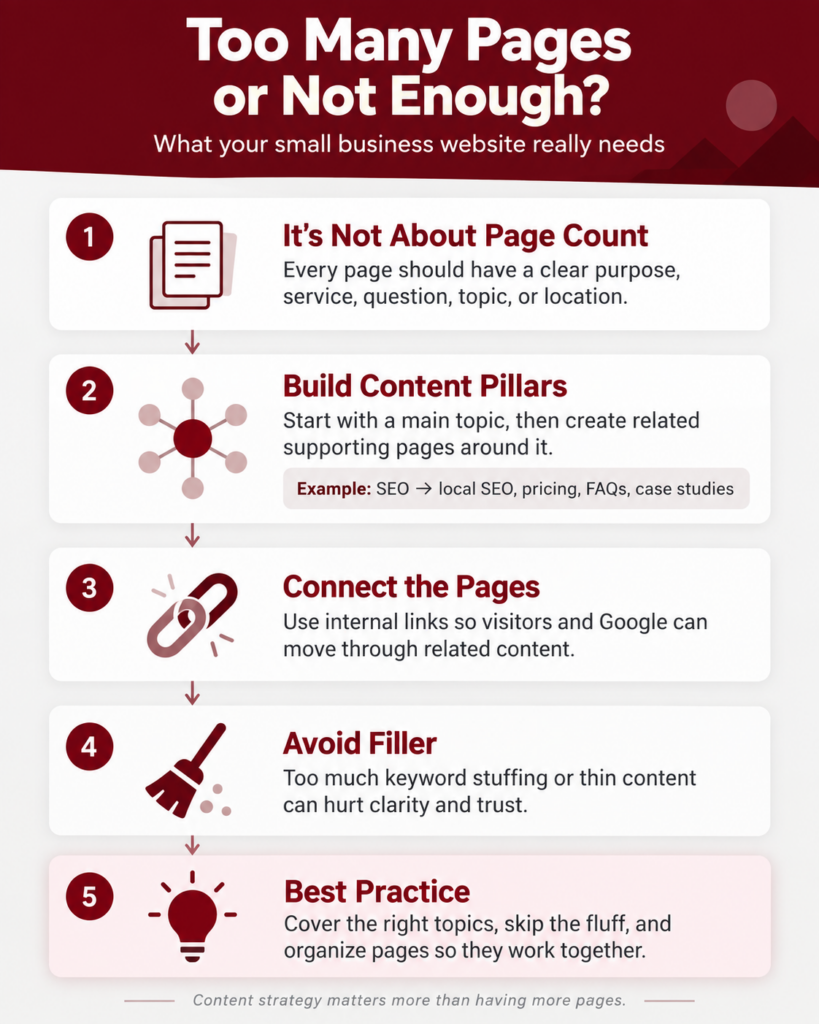
Your small business website probably does not have “too many” or “too few” pages based on a magic number. The real question is whether each page has a purpose. A strong website should cover the topics, services, locations, and customer questions that matter to your business without publishing filler just to make the site look bigger. For most businesses, that means creating a few strong content pillars, then building useful supporting pages around them. Done correctly, those pages help customers understand what you offer while giving Google and AI search tools more context about your business, services, expertise, and geographic relevance.
In this article:
–Focus on purpose, not page count: Every page should support a service, customer question, location, or search intent.
–Build around content pillars: Create strong main topics, then branch into related pages and connect them with internal links.
–Avoid filler and keyword-stuffed pages: For businesses in Boone, Blowing Rock, Banner Elk, and West Jefferson, useful local content matters more than publishing more pages just for SEO.
Kingdon Marketing helps increase views and conversions on your website with SEO. Check out services and contact us when you’re ready to increase revenue for your small business.
There Is No Perfect Number of Website Pages
A five-page website might be enough for a very simple business. Another company may legitimately need 50, 100, or even several hundred pages.
Page count by itself tells you almost nothing.
A landscaping company serving Boone, Blowing Rock, Banner Elk, and West Jefferson may need separate service pages, location pages, project galleries, FAQs, and educational articles. A small consultant offering one specialized service nationwide might need far fewer.
The goal is not to hit a certain number. The goal is to make sure someone searching for an important service, question, or problem can find a useful page on your website.
If there is an important topic related to your business that you have never addressed, you may not have enough content.
If you have 20 pages saying almost the exact same thing, you probably have too much.
Build Your Website Around Content Pillars
One of the cleanest ways to structure a website is through content pillars.
A content pillar is a major topic that your business wants to be known for. Supporting pages then branch off that topic and answer more specific questions.
For example, a web design company might have a main Website Design service page. Supporting content could include:
- Website Design for Small Businesses
- How Much Does a Small Business Website Cost?
- Signs Your Website Needs a Redesign
- Website Design for Restaurants
- Website Design for Home Service Companies
- Why Your Website Is Getting Traffic but Not Leads
Each supporting page covers a slightly different search intent. Those pages can then internally link back to the primary website design page and to other relevant articles.
That creates a clear structure for both people and search engines.
Instead of publishing random blogs whenever somebody thinks of a topic, you are intentionally building authority around the subjects that matter to your business.
Internal Linking Helps Connect the Pieces
Creating pages is only part of the strategy.
They also need to connect.
Internal links help visitors move naturally through your website while helping search engines understand how your pages relate to one another. A blog about local SEO might link to your primary SEO service page. Your SEO page might link to a case study. The case study could link to a contact page.
That path matters.
When it comes to SEO, a website should feel more like an organized library than a drawer full of unrelated papers.
Your strongest pages should not be sitting three or four clicks away from everything else. Important services, locations, and resources should be connected through logical internal links.
This also gives older content more value. Instead of publishing a blog and forgetting about it, you can continue adding links between new and existing resources as your website grows.
The Problem With Creating Pages Just for SEO
More content can help your SEO.
More bad content usually does not.
Some businesses hear that Google likes content and immediately start creating hundreds of nearly identical pages. Maybe there is one page for “SEO Boone NC,” another for “SEO Services Boone NC,” another for “Boone SEO Company,” and another for “Best SEO Boone.”
Technically, those are different keywords. To a customer, though, they are basically the same thing.
That is where SEO can start looking less like helpful marketing and more like keyword stuffing.
You do not need a different page for every tiny keyword variation. A strong page can naturally cover several closely related phrases.
Every page should have enough unique value that you could comfortably explain why it exists.
Watch Out for Thin Content and Filler
Thin content is another common problem.
Maybe you have a location page with three sentences and the city name repeated eight times. Or a service page that says very little beyond, “We provide great service. Contact us today.”
That page technically exists, but it is not doing much for the visitor.
Useful pages should answer real questions.
Explain what you do. Explain who the service is for. Talk about the process. Include examples. Address common concerns. Provide related resources. Make it easy for someone to understand the next step.
You do not need 2,000 words on every page either. Length should follow usefulness, not the other way around.
Sometimes 500 focused words beat 1,500 words of filler.
How Do You Know If Your Website Needs More Pages?
Look at what your customers are actually searching for and asking about.
Your website may need more content if you have important services that are only mentioned briefly on your homepage, serve multiple meaningful geographic markets without dedicated location information, frequently answer the same customer questions by phone, or have expertise that never appears anywhere on your website.
Google Search Console can also help uncover opportunities. You may find that your website is receiving impressions for a topic but does not have a page specifically addressing it.
That can be a good signal that a supporting article or service page deserves to exist.
Your Website Should Grow With Your Business
A good website is rarely finished.
As your company adds services, enters new markets, completes projects, earns reviews, and learns what customers care about, your website should grow too.
That does not mean publishing content simply because your SEO calendar says Tuesday needs a blog — it means building a useful collection of pages that supports the way people search and make buying decisions.
At Kingdon Marketing, we help small businesses in Boone, Blowing Rock, Banner Elk, West Jefferson, and beyond structure websites around real business goals. That can include web design, SEO, content strategy, blogging, local SEO, and ongoing optimization.
The best small business website is not the one with the most pages. It is the one that covers the right topics, organizes them clearly, connects related content, and gives potential customers useful information at every stage of their decision.
If you are unsure whether your website needs more content or needs a cleanup, call Kingdon Marketing at (828) 278-9154. We can help you figure out what should stay, what should go, and what your website is still missing.
Other Articles to Checkout:
- Should You Put Your Prices on Your Website?
- Why People Visit Your Website but Never Contact You
- How Many Website Visitors Do You Need to Generate a Lead?
- 7 Signs Your Small Business Is Ready to Hire an SEO Agency
- How Do You Know If You’re With the Right SEO Company?
- Is SEO Worth It for a Small Local Business? How?