Backlinks are one of the most talked-about parts of SEO, and honestly, one of the most misunderstood. A backlink is simply when another website links to your website. Sounds small, right? But in SEO, those links can help search engines understand that your business is trusted, relevant, and worth showing to more people. For small businesses, the best link building strategy is not buying random links or chasing internet tricks. It is earning real links through helpful content, strong local relationships, and a reputation people want to talk about.
In this article:
–Earn backlinks through real local relationships: Sponsorships, partnerships, PR, and Boone, NC community involvement can create trusted links naturally.
–Focus on reputation before tactics: In local SEO, quality backlinks often come from how well your business serves customers, vendors, and partners.
–Create content worth linking to: Helpful blogs, guides, FAQs, and service pages give trusted websites a real reason to link back to your business.
Kingdon Marketing helps increase views and conversions on your website with SEO. Check out services and contact us when you’re ready to increase revenue for your small business.
What Is SEO Link Building?
SEO link building is the process of getting other websites to link back to your website. These links can come from local directories, news articles, partner websites, blog posts, sponsorship pages, event listings, professional associations, and other online sources.
Search engines view quality backlinks as trust signals. If a respected local news site, chamber of commerce, nonprofit, vendor, or community partner links to your website, it can help show Google that your business is legitimate and connected.
But here is where things get a little spicy.
Not all backlinks are helpful. Some are weak. Some are spammy. Some can even hurt your SEO if they come from low-quality websites or paid link schemes. That is why small business link building should not be about collecting as many links as possible. It should be about earning the right links from the right places.
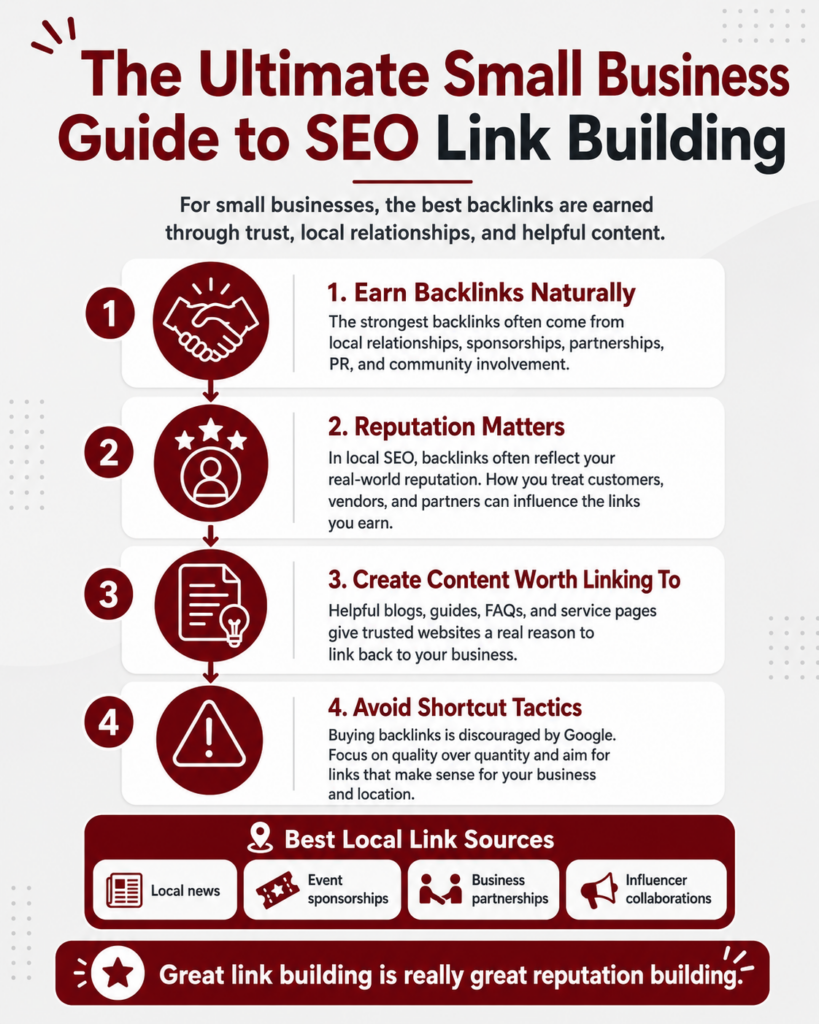
The Best Backlinks Are Earned, Not Forced
When it comes to link building, the best backlinks usually come from trust. They come from real relationships, real value, and real community involvement.
A local restaurant may earn backlinks by sponsoring a school fundraiser, getting featured in a food blog, partnering with a nearby hotel, or hosting an event that gets picked up by a local publication.
A real estate agent may earn backlinks by publishing helpful neighborhood guides, collaborating with local businesses, getting mentioned in community resources, or supporting local events.
A contractor may earn backlinks from vendor relationships, builder associations, local sponsorships, customer stories, or helpful project guides.
See the pattern? It is not magic. It is reputation.
For local SEO, backlinks often say more about your personal reputation than your technical SEO strategy. How you treat people matters. How you show up in your community matters. How you support customers, vendors, employees, partners, and local organizations can directly influence the links and mentions your business earns online.
That may sound old-school, but it works.
Why Backlinks Matter for Small Business SEO
Backlinks can help your website build authority. They can also send referral traffic from another website to yours. If someone reads an article about the best home service companies in town and clicks through to your website, that link is doing more than helping SEO. It is creating a real business opportunity.
Strong backlinks can support:
- Higher visibility in search results
- More trust with Google and potential customers
- Better local SEO performance
- Referral traffic from relevant websites
- More brand awareness in your community
- Stronger authority around your services and location
The key word here is relevant. A backlink from a trusted local website, industry publication, chamber of commerce, or community partner is usually far more valuable than a random link from a website no one has ever heard of.
Why Buying Backlinks Is a Bad Idea
Buying backlinks is one of those SEO shortcuts that sounds tempting until you look at the risk.
Google strongly discourages paid links that are meant to manipulate rankings. That means if you are paying someone to place links on random websites just to boost SEO, you are entering risky territory. It may work for a little while. It may do nothing. It may also cause your website to lose trust.
And let’s be honest, small businesses do not need more mystery problems.
You need marketing that builds your business, not marketing that creates a cleanup project six months later.
This is why I do not recommend buying backlinks. A better approach is to build a business and marketing presence that naturally earns mentions. It may take longer, but it is cleaner, more trustworthy, and usually better aligned with long-term growth.
Local Link Building Starts With Local Relationships
For small businesses, the most practical link building strategy is community involvement.
This does not mean you have to become the mayor of your town or attend every ribbon cutting with a name tag and a forced smile. It means being intentional about the relationships your business already has.
Think about the people and organizations connected to your business:
- Local nonprofits you support
- Events you sponsor
- Vendors you work with
- Contractors or partners you refer
- Local media contacts
- Business associations
- Schools, churches, or civic groups
- Influencers or creators in your area
- Clients who publish resources or partner pages
Many of these relationships can naturally lead to backlinks. A sponsorship page may include your logo and website link. A partner may list your business as a recommended provider. A local article may mention your company after you support an event. A nonprofit may link to your website after you donate services, time, or resources.
That is link building without feeling weird about it.
Sponsorships, PR, and Partnerships Can Build Links Naturally
Some of the best backlinks come from doing things your business should probably be doing anyway.
Sponsoring a local event can support the community and place your business on an event website. Partnering with another business can create cross-promotion and referral traffic. Pitching a helpful story to local news can lead to a credible media mention. Working with local influencers can create social proof, content, and website traffic.
These are not just SEO moves. They are business moves.
The backlink is a byproduct of something bigger.
That is the sweet spot.
Content Still Comes First
Before you spend too much energy chasing backlinks, make sure your website actually deserves them.
Helpful content gives people a reason to link to your site. If your website has thin service pages, generic copy, no useful resources, and no clear local information, it is harder to earn backlinks naturally.
Strong content can include:
- Local guides
- Service area pages
- Helpful blog posts
- FAQs
- Case studies
- Event pages
- Resource pages
- Industry explainers
- Before-and-after project stories
For example, a blog post about “How to Choose an HVAC Company in Boone, NC” has more link potential than a basic service page that says, “We offer HVAC services.” A detailed neighborhood guide from a real estate agent is more linkable than a generic “homes for sale” page. A restaurant guide to private events, catering, or local food pairings can become a resource people actually share.
Good content satisfies user intent first. It answers the question someone came to Google to solve. Then, over time, it can earn links because it is useful.
Funny how that works.
Citations vs. Backlinks: What Is the Difference?
Citations and backlinks are related, but they are not exactly the same.
A citation is an online mention of your business name, address, and phone number. These often appear on directory sites like Yelp, Apple Maps, Bing Places, industry directories, local business listings, and chamber websites.
A backlink is a clickable link from another website to yours.
Some citations include backlinks. Some do not. Both can support local SEO, but backlinks tend to carry more authority when they come from trusted, relevant websites.
For local businesses, citations help confirm that your business information is consistent across the web. Backlinks help build trust, authority, and referral pathways back to your website.
You want both. But you want both done well.
What Makes a Good Backlink?
A good backlink usually has a few important qualities.
It comes from a website that is trustworthy. It is relevant to your business, location, or industry. It makes sense in context. It sends users somewhere helpful. It does not look spammy, forced, or randomly placed.
A local backlink from a Boone, NC organization to a Boone-based business makes sense. A backlink from a respected industry website to one of your educational blog posts makes sense. A link from a partner website to your services page makes sense.
A link from a random website filled with unrelated posts, awkward anchor text, and hundreds of outbound links? Not so much.
Quality beats quantity here. Every time.
A Better Link Building Mindset for Small Businesses
Link building should not feel like a shady internet game. It should feel like a natural extension of your business reputation.
Be helpful. Be visible. Build real relationships. Publish content worth sharing. Support local organizations. Create resources your customers actually need. Follow through. Treat people well.
That is not just good SEO. That is good business.
Over time, the right backlinks tend to follow the businesses that are active, trusted, and useful in their community. And yes, there is strategy involved. But the strategy works best when it is grounded in something real.
At Kingdon Marketing, we help small businesses build SEO strategies that make sense in the real world. That includes website content, local SEO, Google Business Profile optimization, analytics, and smart link-building opportunities that support long-term growth.
No weird tricks. No inflated jargon. Just clear strategy, honest communication, and practical steps that help your business get found.
Final Thoughts on SEO Link Building
The ultimate small business guide to SEO link building is not about chasing every backlink you can find. It is about earning the right links through trust, value, and relationships.
Yes, backlinks matter. Trusted sites with strong authority can make a real difference. But the best link building often starts offline, in the way you serve people, show up locally, and build a business worth recommending.
Create helpful content. Invest in local partnerships. Support your community. Build a reputation people want to talk about.
That is how small businesses earn backlinks that actually mean something.
Other articles to Checkout:
- 3 Essential SEO Metrics Every Small Business Should Monitor
- 7 Ways Marketing Strategy Impacts SEO for Local Small Businesses
- 3 SEO Versus PPC Approaches for Small Business Marketing
- 7 Key SEO Factors for Boosting Small Business Sales
- 5 Smart SEO Moves for Immediate Small Business Website Visibility
- 9 Must-Know SEO Basics for Small Business Entrepreneurs